



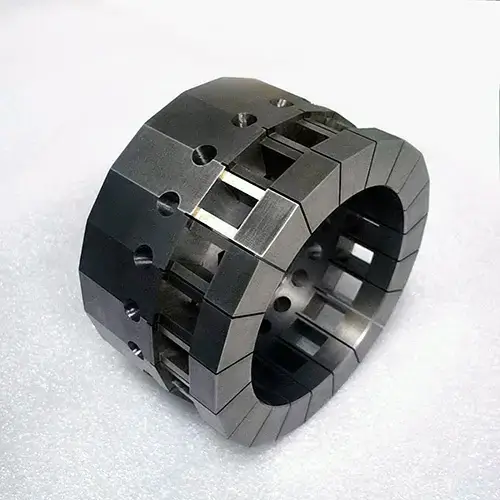
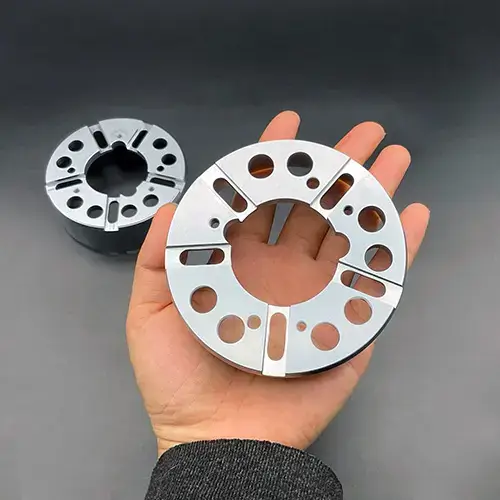
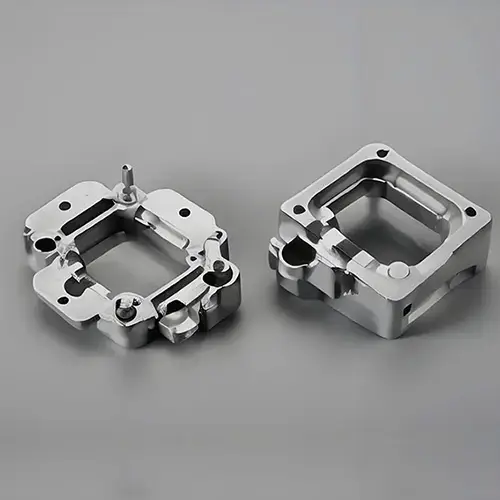
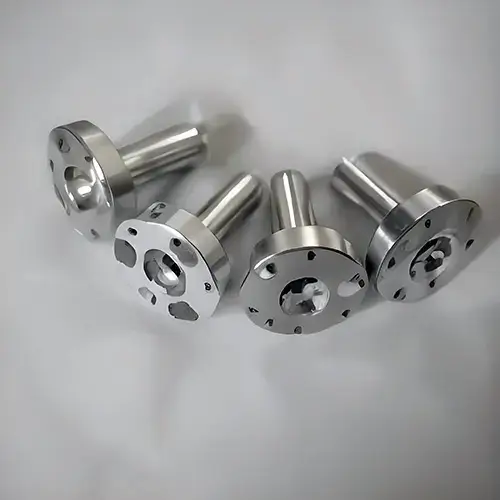
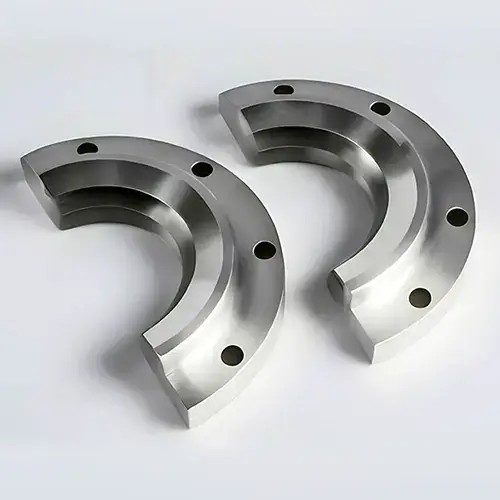
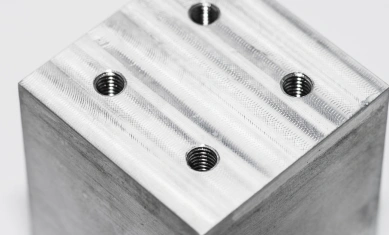
Manufacturer of 5-axis CNC-machined parts

Delivery in as little as 5 days

100% shipment inspection

Full Process Measurement Report

3D Scanning Digital Model Comparison

Free return of defective products

as9100
iOS14000
iso9001

Get a free quote!

Parts Quotation

Drag and drop your files here or click the button below or
STEP | STP I SLDPRT I IPT I PRT I SAT FLES
All uploaded content is secure and confidential.

HomeServices – 5-Axis CNC Milling Services

Manufacturer of ultra-precision 5-axis machined parts

As a leading manufacturer of ultra-precision 5-axis machined parts, SCZY LTD brings decades of expertise to high-stakes projects. Our capabilities span the entire production lifecycle: from material property verification and 5-axis milling to comprehensive post-processing—including full quenching, internal stress relief, precision fitting, electron beam welding, and G1-level dynamic balancing. Every component undergoes 3D model comparison, full-dimension measurement, and strict quality traceability for up to 10 years.

We take quality control to the next level with electron beam welding for precision joints, grinding for smooth surfaces, and dynamic balancing at the G1 level for components that require flawless rotational performance. Our 3D model comparison and full – size measurement processes guarantee that every part we produce adheres precisely to the design specifications. With a remarkable 10 – year quality traceability system in place, you can have complete confidence in the longevity and reliability of our products. To further ensure process stability and feasibility, we offer in – depth FMEA (Failure Mode and Effects Analysis), PFMEA (Process Failure Mode and Effects Analysis), and 5-axis milling 3D simulations, minimizing the risk of delivery delays and ensuring a seamless production process.

5-axis machining capability

Serving turbine blowers, turbochargers, fluid control, lightweight helicopters, automotive modifications, aerospace structural components, medical, semiconductor, and other industries; no MOQ limitations, pilot production and small batches are completed using raw material machining, and casting blanks are provided to optimize cost solutions for long term needs and batch sizes, and X-probe in-house quality inspections are supported.

case

(Signing NDA & SSL Encryption)

Size Metric units Imperial units
Max. part size for all materials
4000 mm×1500 mm×600 mm
158 in.×590 in.×24 in.
Min. feature size
Φ 0.50 mm
Φ 0.002 in.

5-axis machined parts process control focuses

The biggest advantage of 5-axis linkage milling is to realize 5-face machining at one time to avoid multiple clamping errors and dimensional coordinate errors, for the complex structure and material removal, face contour, straightness, coaxiality, full runout, positional, dynamic balance, mechanical properties and other requirements of the parts must be formulated to improve the process control, to avoid the release of internal stresses lead to post-processing deformation, the lower hardness of the material core to affect the mechanical properties The surface treatment of the film thickness changes in the impact.

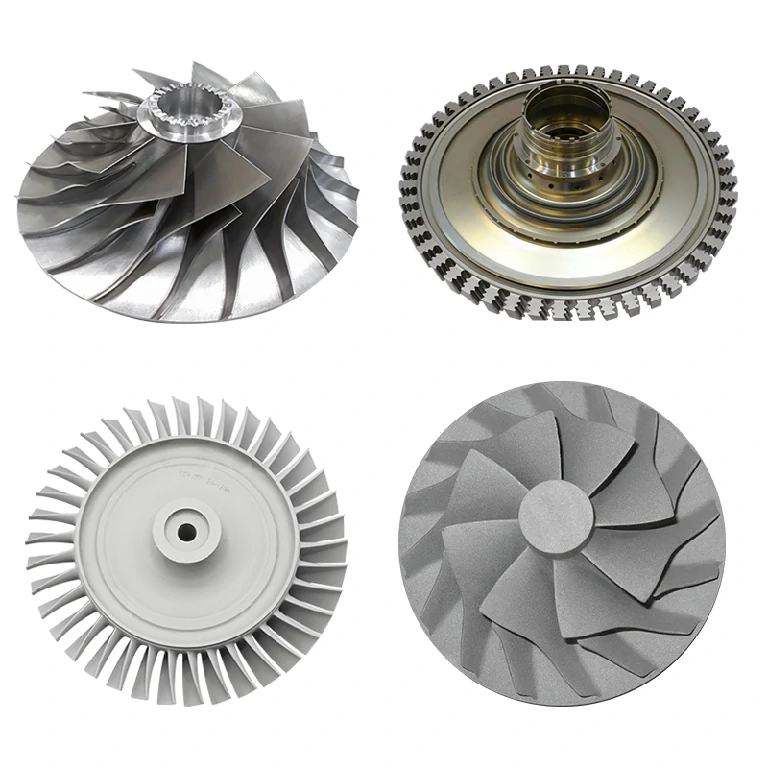
Aluminum impeller 5-axis machining

Control focus:
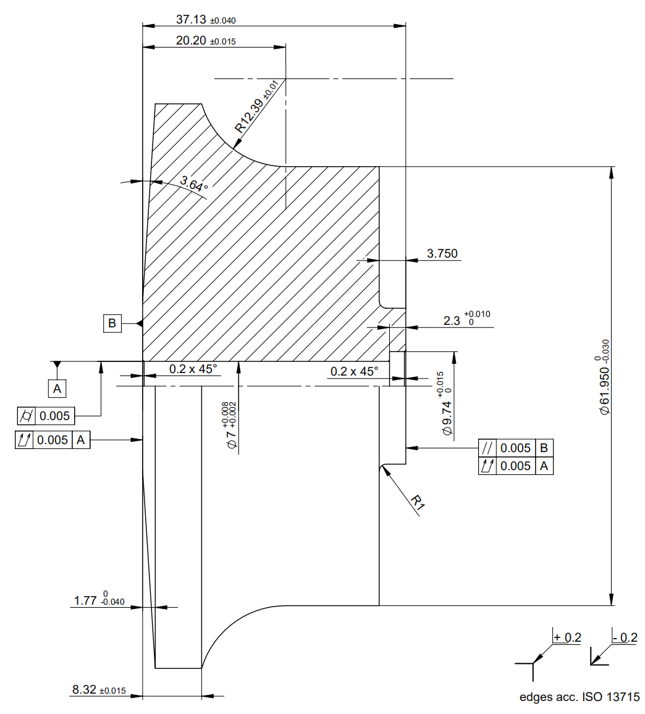
Outer contour geometric surface and shaft centerline full runout, shaft hole tolerance, embodied impeller strict assembly fit tolerance, the actual rotating operation of the centrifugal force, dynamic balance has high requirements, centrifugal force and dynamic balance directly affect the bearing service life, operating noise, the maximum speed limit.

Process technology:
Aluminum alloy cutting performance is better, almost no cutting stress, CNC turning blanks, single side reserved 0.5MM, reserved 5-axis milling blade after the second CNC turning holding parts, this part of the outer diameter finishing roundness 0.002 pipe control, to ensure that the 5-axis milling and CNC turning a one-time turning of the shaft holes and the entire outer contour surface, to ensure that all the cutting links using the axis as the cutting coordinate reference, the

5-axis machining

High-temperature alloy impeller 5-axis machining

Control focus:

Invar belongs to the difficult machining materials, > 30% nickel content has a high toughness, the material is soft, low thermal conductivity, tools are easy to high temperatures, the surface is easy to harden and deformation, low machining efficiency, high tool costs, different impeller structure, choose the optimal roughing program control hours, the use of ultra-wear-resistant coated cutting tools and low-temperature cutting lubricants to control the heat of the cutting to avoid processing the impact of deformation, to complete the geometric contour of all geometric contours and important dimensions of finishing. Finish machining of all geometric contours and important dimensions.

Invar turbine materials are expensive and we are experienced in electron beam welding of shafts and turbines with different materials, weld flaw inspection, internal stress relief and grinding.

Process:
Bar material is selected for trial and small batch production, which is completed by CNC turning blank and 5-axis milling, for long term requirement, casting blank is recommended to optimize the cost of material/roughing/tools, etc. This process is suitable for the production of impellers and multi-layer disks made of stainless steel and titanium alloys.

5-axis machining parts

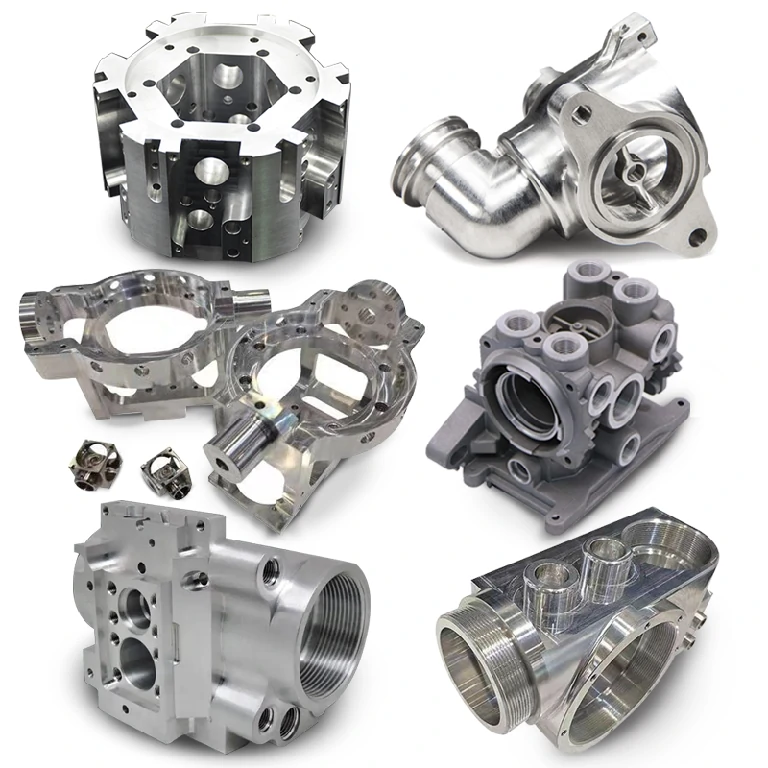
5-axis machining of polyhedral parts

5-axis machining of polyhedral & complex structural parts with curved surfaces can be accomplished in a single process, especially for parts with high dimensional tolerance requirements.

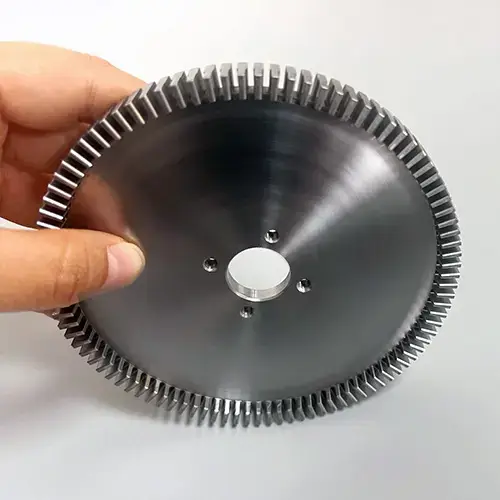
Design verification / trial production / small batch stage 5-axis machining for you to reduce development costs, cavity and profiling, with milling teeth and spline special processing, 5-axis milling equipment for each axis to identify the accuracy of 0.0002mm, the machine supports synchronized size measurement function.

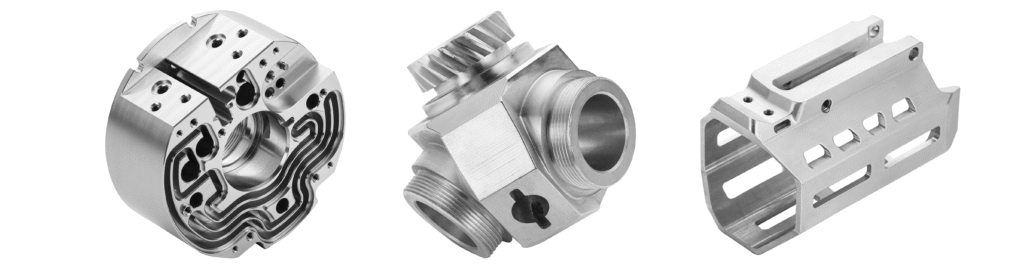
CNC Machining Parts Gallery

Large or small workpieces with machinable lengths and widths of 1–2000 mm. SCZY LTD can also provide surface treatment and assembly services upon request.

5-Axis CNC Machining Surface Treatment

We offer a one-stop, high-quality surface treatment solution that covers a wide range of processes, including sandblasting, anodizing, electroplating, electrophoretic coating, baking, chemical conversion coating, passivation, polishing, blackening, and QBQ protection, to precisely meet the stringent requirements of different industries. Each processing technique is accompanied by professional testing services. We provide detailed film thickness data, hardness test reports, precise color parameters, corrosion-resistant salt spray test results, and authoritative adhesion test reports. These scientific data ensure processing quality, endowing your products with exceptional protective performance and aesthetic appeal, while comprehensively guaranteeing reliability and stability.

As-machined-cnc-finish-1

Standard (As-Machined)

This finish refers to parts just after the machining process, sometimes followed by minor grinding. It contains tool marks, small burrs & chips, but provides tight tolerances. The roughness can be as low as 3.2 μm. This finish is suitable when aesthetics is not a requirement.
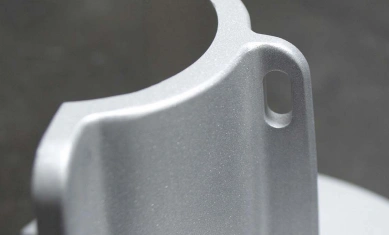
Bead-Blasting-cnc-finish-1

Bead Blasting

Bead blasting strikes the tiny glass, ceramic, or other beads on the machined surface at high pressure to remove tool marks, burrs, chips, and other surface irregularities. It produces a light and smoothie texture with an attractive appearance.
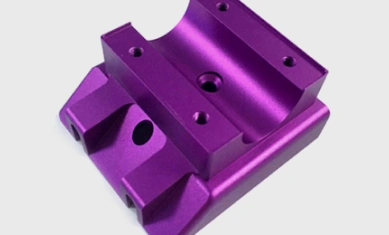
anodized-cnc-finish-1

Anodized (Type II Or Type III)

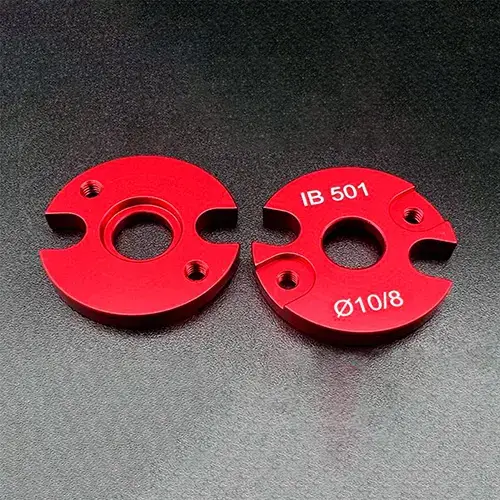
The CNC-machined aluminum or non-ferrous parts can be anodized, which refers to adding and protective oxide layer on their surface. Type II is clear and color anodizing, whereas type III (MIL-A-8625/MIL-PRF-8625) refers to hard coating. Anodized surfaces resist harsh environments and save the parts from corrosion, wear, and surface degradation.
powder-coating-cnc-finish-1

Powder coating

It is the electrostatic deposition of a thin powder layer(powder of epoxy, polyester, etc) and curing at high temperature, up to 400. Powder coat surfaces are highly corrosion-resistant and can be achieved in any color. It is applicable to all material-type machine parts with complex geometries.
polishing-cnc-finish-1

Polishing

Polishing can be applied through electrochemical and mechanical methods. It produces a smooth and fine, mirror-like finish with Ra as low as 0.3 μm. This surface finish is preferred for machined parts if low-surface friction is essential for performance or aesthetics is important.
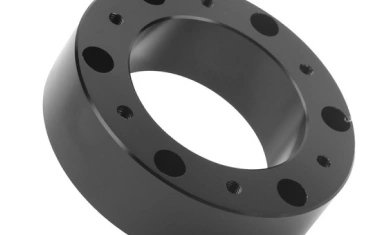
black-oxide-cnc-finish-1

Black-Oxide

Black oxide is a surface treatment for ferrous materials that creates a sleek black appearance and offers mild corrosion resistance. It chemically converts the metal surface into an oxide layer, preserving tight tolerances. This finish is ideal for precision components where a low-reflective, durable surface is desired.
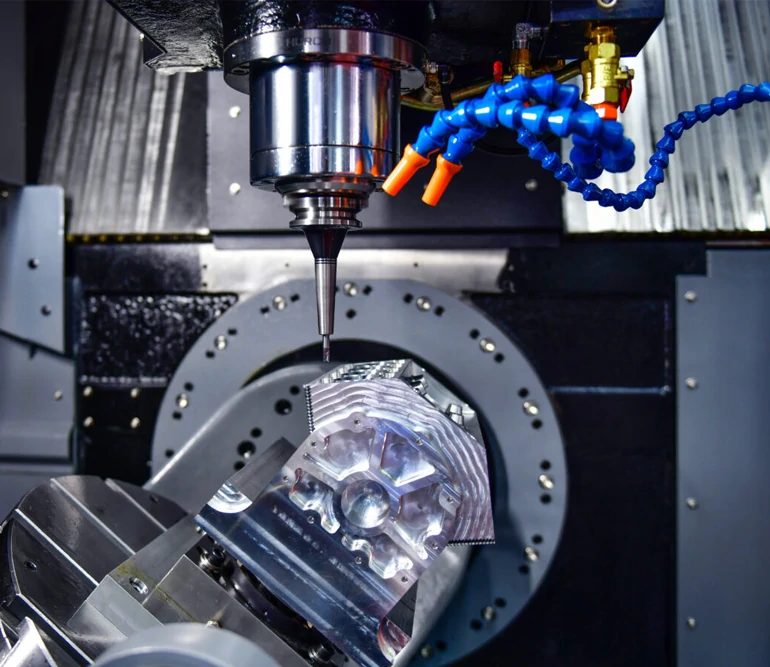
5-Axis CNC Machining Materials

SCZY LTD utilizes advanced five-axis CNC technology to specialize in the machining of metals such as aluminum alloy, brass, and titanium alloy, as well as engineering plastics like ABS and POM. Our customization services offer precision and reliability with a tolerance of ±0.01mm, providing precision parts for industries including aerospace, medical, and automation. Five-axis interpolation enables complex surfaces to be formed in a single operation, reducing setup times and achieving surface finish as fine as Ra ≤ 0.8 μm. From prototyping to small-to-medium-volume production, comprehensive quality control throughout the entire process ensures efficient and reliable delivery.

5-Axis CNC Machining Process

Five-axis CNC machining adds two rotary axes to the traditional three-axis motion. This allows the cutting tool to approach the workpiece from almost any angle, enabling the machining of complex geometries with fewer setups and higher precision.

5 axis cnc

How Does 5-Axis Machining Work?

5-axis machining combines three linear axes (X,Y,Z) with two rotary axes (A/B or C) to move the tool or workpiece in five directions, enabling complex geometry machining in one setup. The rotary axes tilt/rotate the workpiece as the tool follows 3D paths, ideal for turbine blades or implants. Fewer setups reduce errors and lead times, while optimized tool movement enhances surface finish (Ra 0.1μm) and precision—critical for parts needing multi-sided, tight-tolerance machining.

Simultaneous-5-Axis-vs-32-Axis-CNC-Machining

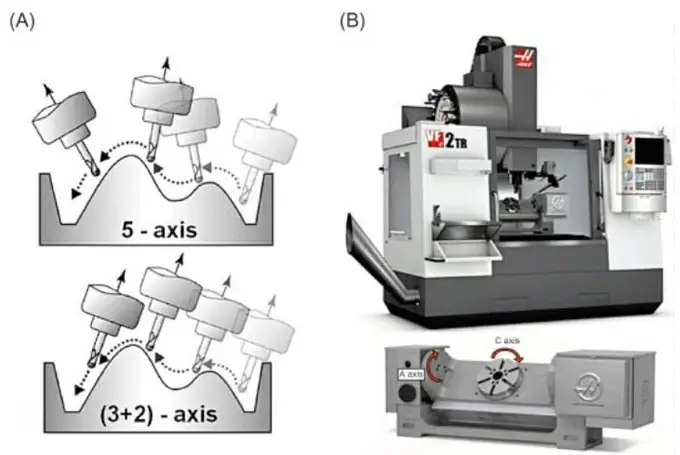
The Difference Between 5-Axis And 3+2-Axis

Motion Principle

  • 5-Axis Machining: All five axes (X, Y, Z + two rotary axes) move simultaneously in real-time, enabling continuous multi-directional toolpath control. The tool can approach the workpiece from any angle, ideal for complex free-form surfaces.
  • 3+2-Axis Machining: Also known as “positioning 5-axis,” it uses three linear axes for cutting while the two rotary axes fix the workpiece at a preset angle (e.g., 30° tilt) during machining. Rotary axes do not move dynamically during the cut.

Extensive Industry Experience

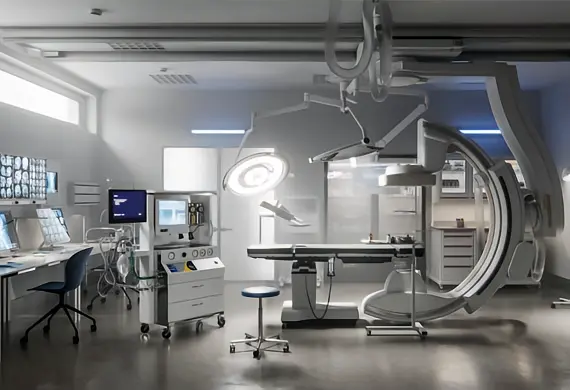
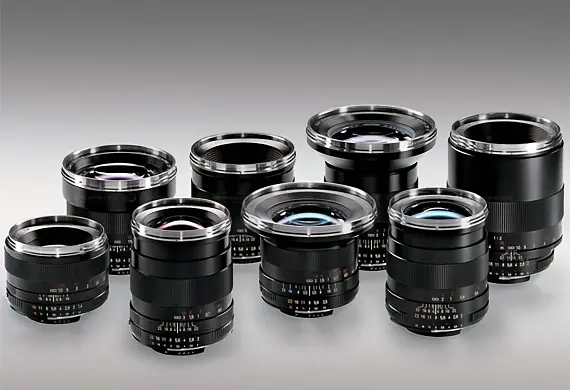
SCZY LTD is an experienced custom machined parts manufacturer that produces parts to serve companies in 20+ countries around the world in the areas of microlight infrared, photoelectric rangefinders, aircraft seats, avionics, high-speed rail communications, new energy vehicles, oil & gas electronic valve bodies, pneumatic & hydraulic solenoid valves, high-speed turbine blowers, turbine water pumps, medical testing equipment, semiconductor and automation manufacturing, smart agriculture, and smart home appliances, Smart Wearable. According to the technical characteristics of parts processing in different industries, we are divided into 5 manufacturing divisions, namely Optics, Fluid Control, Transportation, Intelligent Manufacturing, and 5G Life, to match your needs with professional technology and production services, and to customize the best manufacturing solutions according to your needs.

Automotive

Automotive

Robotics

Robotics

energy

Energy

Medical-Equipment

Medical Equipment

Optical-Lens

Optical Lens

Aerospace

Aerospace

5-Axis CNC Machining FAQ's

Browse our 5-axis CNC milling FAQs to learn more about our 5-axis CNC machining services and how we can support your manufacturing needs.

The accuracy of 5-axis CNC machining typically ranges from ±0.01mm to ±0.005mm (5–10 microns), depending on the machine’s precision, material, and part complexity. High-end systems can achieve tighter tolerances of ±0.002mm for critical applications like aerospace components or medical implants. This precision is enabled by dynamic multi-axis control, high-resolution encoders, and post-machining verification (e.g., 3D scanning), making it ideal for complex parts requiring micron-level accuracy.

The main disadvantages of 5-axis machining include higher initial costs for specialized equipment and CAD/CAM software, complex programming requiring advanced expertise to avoid collisions, and increased maintenance needs for rotary axes and precision components. It also demands a steeper learning curve for operators and may face challenges with hard materials requiring expensive tooling, making it less cost-effective for simple parts or small-batch production compared to 3-axis machining.

The minimum wall thickness for CNC machining varies significantly based on multiple factors. For soft metals like aluminum, it can typically be as low as 0.5mm, while harder materials such as stainless steel or titanium usually require a minimum of 1mm to prevent tool breakage and maintain structural integrity during machining. Engineering plastics like ABS or POM allow for thinner walls, often reaching 0.3mm. However, complex geometries, deeper cavities, and the specific capabilities of the CNC machine, especially 5-axis machines that can optimize cutting angles, also play crucial roles. Advanced 5-axis CNC setups may enable even thinner walls down to 0.3mm by reducing tool deflection, but this requires precise programming and careful material selection.

The tightest tolerance achievable in CNC machining is ±0.001mm (1 micron), reserved for ultra-precision applications like aerospace turbine components, micro medical devices, or optical mounts. This requires specialized equipment (e.g., thermally stabilized 5-axis machines), diamond-tipped tools for non-ferrous materials, and controlled environmental conditions. Most industrial CNC machining typically holds tolerances between ±0.01mm to ±0.005mm, with precision depending on material, machine calibration, and part complexity.

Delivery times vary depending on the complexity and scale of the order. For standard five-axis CNC machining, parts can be delivered in as little as 2-3 days, while more complex projects may take up to 2 weeks.

The cost of five-axis CNC machining services depends on a variety of factors, including materials, complexity, and production volume. Please contact us for an instant quote tailored to your specific project needs.

Talk to our engineers and sales staff

We are committed to providing you with efficient, convenient, and accurate solutions to help you achieve rapid product development and high-quality production. Upload your files now to get your free solution!

CMM inspection

Zeiss & Mitutoyo coordinate measuring machines

Statistical Process Control

Real-time quality monitoring

Material certification

Complete traceability and material test reports

Call Us

Questions about our product or pricing? Call for support

Chat Us

Our support will help you from 9am to 5pm EST.

Get a free quote

Customize your parts with ease!

Please enable JavaScript in your browser to complete this form.
Click or drag a file to this area to upload.
All uploads are secure and confidential
Blog

More CNC Machining Resources

The latest news, trends, and manufacturing design techniques in precision CNC machining.